
 LANG
ENGLISH
中文(繁體)
日本語
A: I literally can't think of anything worth saying.
B: Are you talking to them or me?
A: Who is them?
B: Well anyone else who is here other than me.
A: Erm, I'm talking to both? Maybe? I think I'm talk to anyone who will listen really…
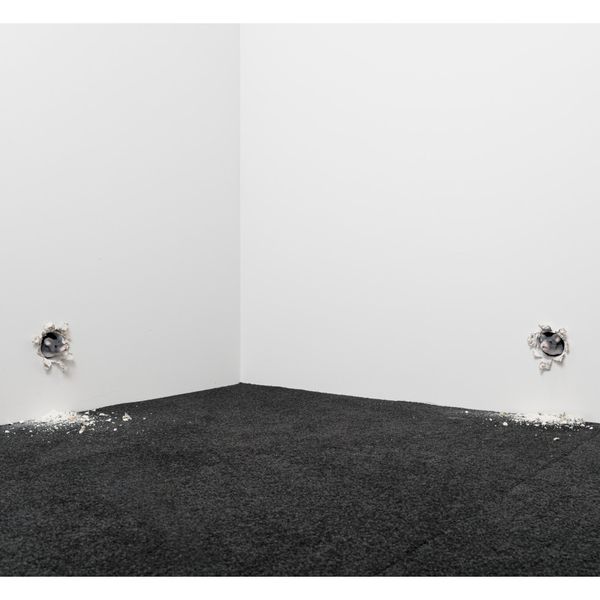
B: You are an animatronic sculpture of a small grey mouse, that has been animated and programmed to speak in a human language.
A: You mean, I'm a… I'm like a robot? You think we're robots?
B: The main differences between me and a real mouse is that I firstly, am not alive and secondly, a real mouse can not speak.
A: Why are you acting so weird Olive?
B: I am edition one of an artwork entitled 'The story is in the telling, 2025' by the British Artist, Ryan Gander.
A: What on earth are you talking about? Is this some kind of stupid game?
B: The concept of my narration was conceived on the 23rd of March, 2025. The words that I am speaking were written as a script by the artist at his house in Suffolk, England, early on that Sunday morning.
A: Yeah you can stop now, it's getting kind of annoying Olive.
B: I was physically assembled and built however,
A: Why are you acting so weird?
B: …by Animatronic Effects Supervisor, Karl Gallivan and Artistic Director, Phil Mayer prior to this event,
A: OK…
B: …and I lay dormant and untouched,
A: I get it…
B: …on a bench in the Artist's studio for several months,
A: It's ridiculous…
B: …before the artist gave me my words and catalysed my potential.
A: Right, I know what you're doing… and it's stupid…
B: My voice is in fact that of one of the artist's three children. This recording was made on 29th of March, 2025 in a recording studio, by Olive May Gander age 15 years old. Your voice was recorded by Penelope Eve Gander, age 11 years old, at the same time.
A: What do you mean? This is my voice! I am Penny!
A: STOP, please, it's so annoying. Really winding me up now!
B: As an artwork I exist in an edition of three identical copies,
A: OK fine, whatever.
B: …as well as an 'artists proof' copy, which is traditionally retained by the artist, but is often sold by Ryan Gander to raise the financial capability to pay for other commercially less viable research, development and production of new and experimental artworks.
A: Well, as my mammy mouse always said, like the suburban Buddhist that she was,"There's no pockets in a shroud".
B: The value of all artworks is assigned based on the market value of the artists work relating to previous works sold to private collections and public institutions. Although due to additional costs, and dis…
A: But hold on, what is the cost of this artwork if I wanted to buy it? Although I'm not sure I could actually afford to buy it myself.
B: …although due to additional costs, and discounts like most artworks this artwork is likely to sell for 10 to 20% less, depending on whether the collection acquiring it is public or private. Meaning if the work is shown freely to the public, the discount is greater, whilst if the art work is not able to be seen by everyone the discount is lower.
A: I hope we're getting paid! Hey ask Dad if we're getting paid Olive!
B: Could you please stop interrupting?
A: I've got a question…
B: The 900% mark up margin between production cost and sale value is an often used as a gauge for an artwork of this nature, but for many works like painting, the mark up is far more lucrative, with the production cost making up maybe even less than 1% of the sale value.
A: Wait can't I ask questions? Your maths spiel is so boring, you know.
B: My original production and debut,
A: There's no magic in what you're saying. You're like a machine!
B: …was scheduled and initiated specifically for an exhibition entitled "Ryan Gander: YOU COMPLETE ME" at the POLA MUSEUM OF ART, running from the 31st of May 2025 to the 30th of November, 2025. The museum was built in 2002 under the tree line of a forest near to mount Fuji in Hakone national park in the Kanagawa Prefecture, of Japan.
A: God, you really know how to ruin the magic don't you? You could talk a glass eye to sleep. The machines Olive, they are precise, they're on time, they're repetitive and productive… but they dream of being free Olive!
B: We are here to tell you about ourselves. We are an artwork by the British artist Ryan Gander. We have been conceived with a variety of objectives, but the primary objective is to make a great work of art, one that is better than the artwork of his peers. For the Artist, the yardsticks of measuring a great artwork includes the ability to surprise people and defy expectation, the ability to produce an artwork that makes an original contribution to the history and human knowledge, the ability to encourage you the viewer, to think differently about the world around us, but most of all, above any other goal is the ability to achieve a positive jealousy in the artists around him that he most respects. This is known in the artist's world as an 'Artists Artist'. Pleasing or challenging the audience, pleasing or challenging yourself, making money, creating attention and gaining an institutional reputation are all second to attaining respect and notoriety from other artists. You see for pioneering and avant-garde artists that work to push boundaries, and challenging traditional notions of authorship, distribution, interaction, media and authority… a sense of competition can be a driving force.
A: Err. Excuse me? You mean, when you feel jealous of what your friend's doing, it makes you want to go straight to the studio and try harder?
B: Well not me exactly but yes, the artists. That's what I said… To achieve these objectives… tools are employed by the artist to create emotional responses, these include intrigue, disbelief, seduction, empathy, confusion, humour, patience, humility, sorrow, love, joy, uncertainty and ambiguity amongst many others. They stop you from immediately disregarding it and moving on. These tools manipulate you into engaging with the artwork. And they subtly encourage you to create a relationship with the artwork, without you even realising it.
A: Well I can see two mice…
B: A good artist has the ability to make an artwork personable.
A: I can see two mice, well actually, I can only see one mouse, cause I am the other mouse, but if I was the viewer, I'd be able to see two mice talking… you and me, or me and you that is…
B: Ok, but we're not mice, we are animatronic sculptures of small grey mice, that have been animated and programmed to speak in a human language.
A: Not to me… to me when I imagine I'm real, I am real… Maybe you should pretend we are real? Can you pretend we're real?
B: Reality depends on the suspension of disbelief.
A: That's not an answer to my question though. Can you pretend we're real?
<Clears throat>
B: You see, when we approach an artwork for the first time, we understand it by deciphering a massive amount of complex signs and signifiers that tell us information about that artworks position in the world. The study of signs and language is called semiotics, but artists just call this 'The Read'. In those first moments of confronting an alien object, thousands of questions and answers fly through our minds in a nanosecond without us even acknowledging it. We use the wealth of answers to questions we have previously asked ourselves to speed up this process. We use our assumptions and prejudices from the evidence of previous experiences to fill in all the gaps.
A: How do you know that's what I do? How do you know I decipher things? Maybe I just feel things, maybe 'The Read' for me is based purely on vibes. Why is mutual understanding an objective for you? Why can't we feel different things to one another? Why do you want everyone to feel the same thing?
B: When we confront a new object for the first time we innately…
A: Oi! Mouse… Answer my questions?
B: You can feel whatever you want.
A: Why don't you answer my questions? Why do you answer questions with a different question? Why do you deflect all the questions that you can't answer? Did they teach you that in private school? That's how presidents and primisters answer questions… or actually that's how they don't answer questions…
B: Please, can I continue?
A: I don't mean to be rude, but you should answer questions you know…
B: May I?
A: I'm sure you will continue no matter what I say…
B: When we confront a new object for the first time we innately and subconsciously ask ourselves a series of questions to position that thing in a hierarchy of all the other things in the world. What is its use? What is its Cost? What is its function? What is its worth? What is its value? Who is its owner? Who is its author?
A: Yeah alright, got it… use, cost, function, worth, value, ownership, authorship, motive…
B: No not motive… I didn't say motive.
A: Yeah motive… I know you didn't say it, but, but you should of said it. You see 'motive' is everything according to you. You already said that the motive of being an 'Artists artist' is paramount. And I think, if you will allow me to think for myself… I think that when an artist can answer what their actual motive for making art is, and if they are completely honest with themselves in answering that question, then they will exercise themselves of their uncertainty, fear and procrastination.
A&B: Procrastination?
A: Yes, procrastination. The artists greatest weakness. You know talking themselves out of actually making or committing to any idea or thing.
A&B: Hhhmmmm
A&B: Ask yourself, go on. What's your motive?
A&B: Oh sorry I forgot you don't answer questions do you?
A&B: You've gone quiet?
A&B: What is worth saying?
A&B: Sorry?
A: It’s been such a long time, since I was in love…
Extra takes
Erm
Em
Well
Uh-huh
Hmmm
Mmmm
I.. I..
Awwww
Argh!
Airrrr
Sigh
Arrggwww
Yawn